Where Did Goldfish Crackers Originate?

Where Did Goldfish Crackers Originate?
Updated May 2026 10 min read 2,800 words
B
Bryan Denning

Bryan Denning is a content writer who creates clear, engaging, and easy-to-understand blogs and news content across a wide range of industries. Over the years, he has worked on topics ranging from beauty, eCommerce, and lifestyle to digital marketing and consumer products.

Introduction

If you’ve ever reached into a bag of Goldfish crackers and popped one of those tiny smiling fish into your mouth, you’ve taken part in one of the most beloved snack traditions in America. But where did Goldfish crackers originate? The answer might surprise you — because these iconic baked snacks didn’t start in the United States at all.

From a Swiss bakery’s creative idea in the 1950s to the shelves of virtually every American grocery store today, the journey of Goldfish crackers is a story of clever marketing, family love, and the kind of snack innovation that stands the test of time. Whether you’re a longtime fan or just curious about the history behind this crunchy classic, you’re about to get the full picture.

In this post, we’ll cover the complete origin story of Goldfish crackers — who invented them, when they arrived in the U.S., why they’re shaped like fish, and how they’ve evolved into the cultural snack icon they are today.

The Origin of Goldfish Crackers

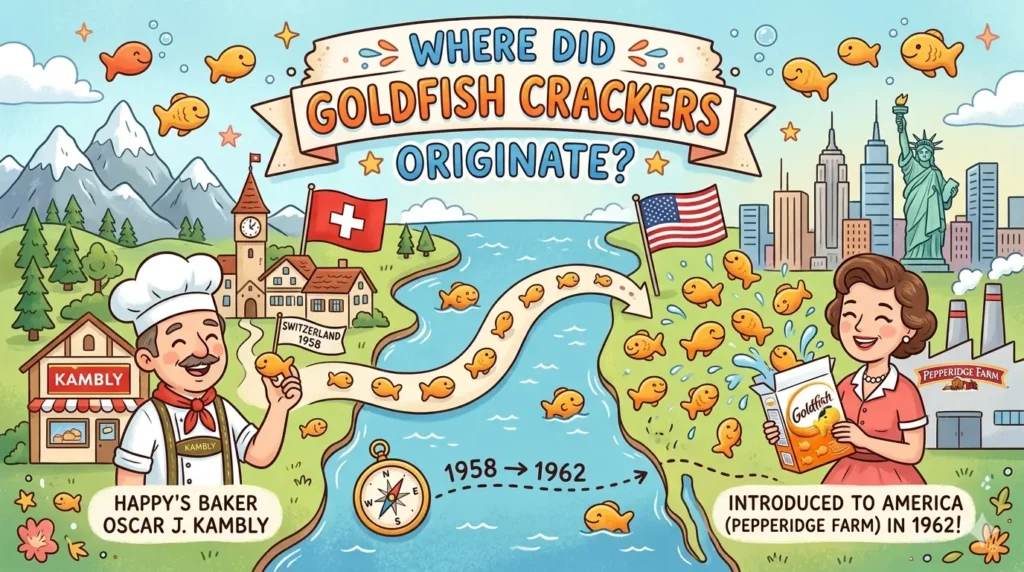
The story of Goldfish crackers begins not in a massive food factory, but in a small European bakery. Goldfish crackers were created in Switzerland in 1958 by Oscar J. Kambly, a Swiss baker and biscuit maker. Kambly developed the original Goldfish-shaped cracker as a birthday gift for his wife, whose astrological sign was Pisces — the fish.

The charming fish shape wasn’t just random. It was intentionally designed to represent something personal and meaningful. The little crackers were small, bite-sized, and shaped like swimming fish — an intimate, thoughtful gesture that eventually turned into a global product.

Quick Answer: Goldfish crackers originated in Switzerland in 1958. They were created by Swiss baker Oscar J. Kambly as a birthday present for his wife, a Pisces. The cracker was later licensed to Pepperidge Farm, which brought it to the United States in 1962.

Kambly was the owner of a well-established Swiss biscuit company, and he had both the means and the creativity to design something unique. The crackers were initially baked as a novelty, but the fish shape, size, and savory flavor profile quickly caught the attention of other food companies — most notably a Connecticut-based bakery called Pepperidge Farm.

The Swiss origin of Goldfish crackers is not widely known, which makes it one of those fascinating food history facts that often surprises people. Most Americans assume the snack is 100% homegrown, but the roots of this beloved cracker go all the way back to the Alps.

Who Invented Goldfish Crackers?

The credit for inventing Goldfish crackers goes to Oscar J. Kambly, a Swiss biscuit manufacturer. Kambly was the founder of the Kambly company, which is still one of Switzerland’s most recognized biscuit brands today. But while Kambly invented the original fish-shaped cracker concept, the version most people around the world recognize was refined and scaled by Pepperidge Farm.

Kambly’s Original Creation

Oscar Kambly’s original Goldfish crackers were quite different from the modern version. They were more of a European-style biscuit — thin, delicate, and mildly flavored. The fish shape was the defining feature. Kambly’s biscuits were already well-known in Switzerland, and the Goldfish design was just another creative output from his innovative bakery.

Pepperidge Farm’s Role

The transformation from Swiss novelty to American snack staple happened when Margaret Rudkin, the founder of Pepperidge Farm, discovered Goldfish crackers while traveling in Europe. She tasted the little fish-shaped biscuits, recognized their potential in the American snack market, and licensed the design from Kambly in 1962.

Margaret Rudkin is a remarkable figure in American food history. She had originally founded Pepperidge Farm in 1937 to bake stone-ground whole wheat bread for her son, who had a wheat allergy. Her attention to natural, wholesome ingredients set the tone for Pepperidge Farm’s identity, and that same philosophy applied when she introduced Goldfish to American consumers.

After licensing the concept, Pepperidge Farm reformulated the cracker to suit American tastes — making it cheesier, crunchier, and slightly more robust than the original Swiss version. The iconic smiling face wasn’t part of the original design and was added later to give the crackers more personality and kid appeal.

When Did Goldfish Crackers Come to the United States?

Goldfish crackers officially arrived in the United States in 1962, after Margaret Rudkin of Pepperidge Farm secured the rights to produce and sell them in North America. The timing was ideal — American snack culture was booming, and consumers were hungry for fun, convenient, bite-sized foods.

1958

Swiss Origin

Oscar J. Kambly creates the first Goldfish-shaped cracker in Switzerland as a gift for his wife.

1962

U.S. Launch

Pepperidge Farm licenses the design and launches Goldfish crackers in the American market after Margaret Rudkin discovers them in Europe.

1997

The Smile Arrives

Pepperidge Farm adds the iconic smiling face to the Goldfish cracker, making it more playful and memorable for younger audiences.

2001

Pepperidge Farm Acquired

Campbell Soup Company, which had acquired Pepperidge Farm in 1961, further integrates Goldfish into its large consumer product portfolio.

Today

Global Icon

Goldfish crackers are sold in dozens of countries and remain one of the top-selling snack crackers in the United States.

The introduction was initially modest, targeted toward families as a wholesome, fun snack. But word spread fast. Within a few years, Goldfish had become a household staple — not just for children, but for adults looking for a light, satisfying snack. To learn more about the full invention timeline, visit our detailed post on when Goldfish crackers were invented.

Why Are Goldfish Crackers Shaped Like Fish?

The fish shape wasn’t a marketing gimmick — it was deeply personal. As mentioned, Oscar Kambly created the original cracker as a gift for his wife, who was a Pisces (the astrological water sign symbolized by fish). The fish shape was a loving nod to her birthday.

When Pepperidge Farm brought the design to the U.S., they retained the shape because it was so distinctive and memorable. A fish-shaped cracker stood out in a sea of round, square, and rectangular snacks. It created an instant point of difference on store shelves and made the product feel playful and unique.

Over time, the shape became part of the brand’s identity. The addition of the smile in 1997 amplified that personality — suddenly each cracker wasn’t just a fish, it was a cheerful little character. That small design decision had an enormous cultural impact, helping to build generations of brand loyalty among children and parents alike.

🐟 Why the Fish Shape Works So Well

  • Instantly recognizable — no other snack looks like it
  • Kid-friendly and fun to eat
  • Bite-sized shape fits perfectly in small hands
  • The smiling face creates an emotional connection
  • Memorable enough to be iconic after more than 60 years

Evolution of Goldfish Crackers Over Time

From a single Swiss biscuit to a product line with dozens of varieties, Goldfish crackers have undergone significant evolution over the past six decades. What started as a simple cheese cracker has expanded into a diverse range of flavors, textures, and limited-edition releases that keep fans coming back.

Early Years (1962–1990s)

When Pepperidge Farm first launched Goldfish in the U.S., the original flavors were simple: lightly salted and cheese. The crackers were marketed as a refined snack — something you might serve at a cocktail party alongside olives and wine. This wasn’t a kid’s snack at first; it was actually positioned as an adult appetizer.

Going Mainstream (1990s–2000s)

The real pivot came in the late 1990s when Pepperidge Farm began actively marketing Goldfish to children and families. The introduction of the smiley face in 1997 was a game-changer. Marketing campaigns emphasized fun, play, and the classic tagline “The snack that smiles back.” Suddenly Goldfish were everywhere — in lunchboxes, at birthday parties, and in after-school snack bowls.

New flavors began rolling out to meet demand: Cheddar (which became the best-selling variety), Pizza, Pretzel, and Parmesan. Each new variety brought new fans into the fold. Check out our comprehensive guide to Goldfish Crackers flavors for a complete breakdown of every variety available today.

Innovation Era (2010s–Present)

In the 2010s and beyond, Pepperidge Farm began experimenting with sweeter flavors and crossover products. Goldfish Grahams — a sweeter, cookie-style version of the fish cracker — became hugely popular, especially for younger snackers. Limited-edition collaborations and seasonal flavors kept social media buzzing and brought new energy to the brand.

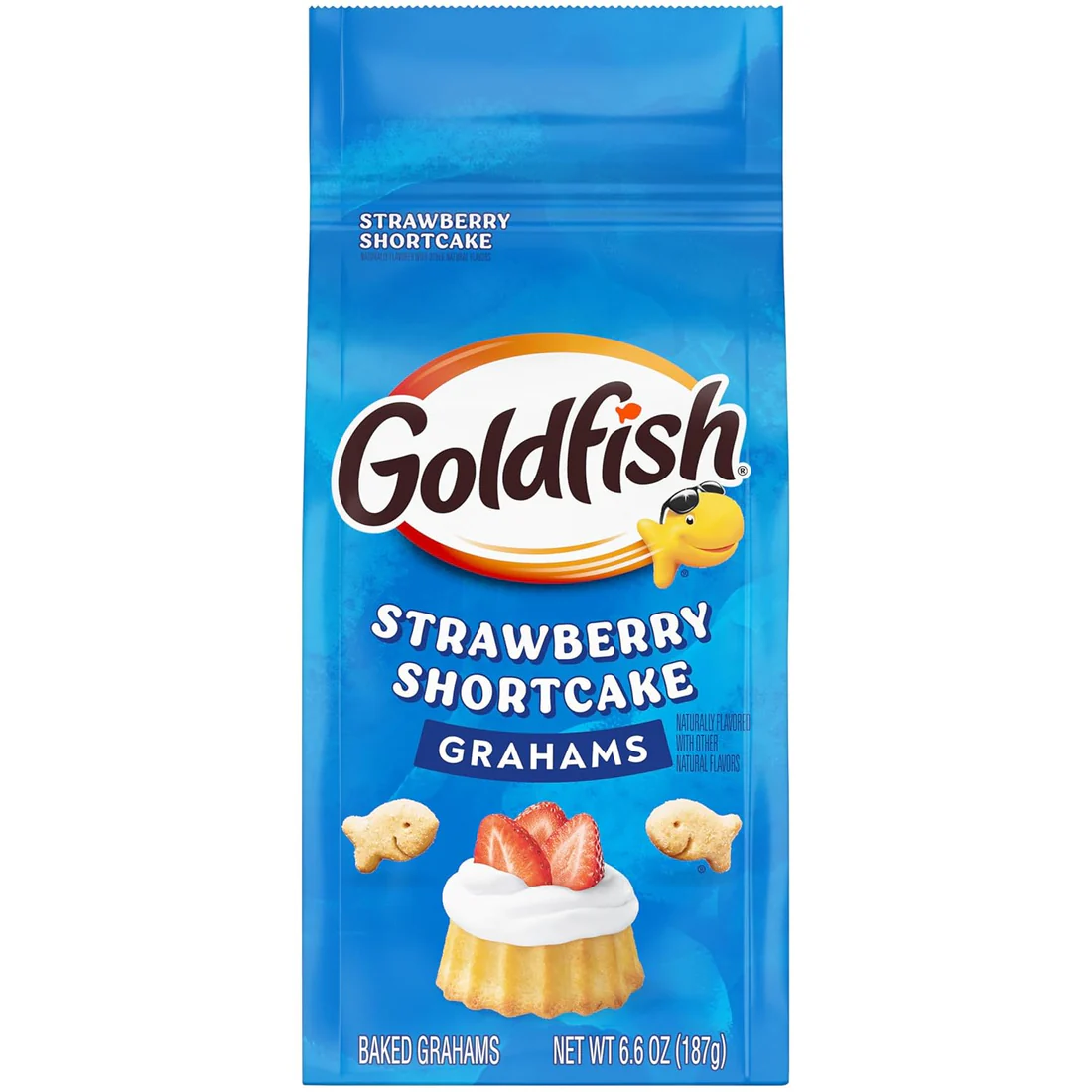
One standout innovation is the Goldfish Grahams Strawberry Shortcake flavor — a sweet, dessert-inspired cracker that brings the cozy flavor of strawberry shortcake to the beloved fish shape. It’s become a fan favorite for those who want something a little sweeter without leaving the Goldfish family.

🍓 Try the Fan-Favorite Flavor

A sweet twist on a classic snack — perfect for dessert, lunchboxes, or anytime cravings.

Goldfish Grahams Strawberry Shortcake Flavored Snack Crackers – buy online 60% OFF

Goldfish Grahams Strawberry Shortcake Flavored Snack Crackers

$4.00 $10.00 Save $6
🛒 Buy Now — Limited Stock

✅ Fast shipping  |  ⭐ Fan favorite flavor

Who Owns Goldfish Crackers Today?

Today, Goldfish crackers are owned and produced by Campbell Soup Company through its subsidiary Pepperidge Farm. Campbell’s acquired Pepperidge Farm back in 1961 — just before Goldfish were even introduced in the U.S. — and the two companies have grown the Goldfish brand together ever since.

Campbell Soup Company is one of the largest food corporations in the world, and Goldfish crackers are one of its most important and profitable product lines. The brand generates over $1 billion in annual retail sales, making it a flagship product in Campbell’s snack portfolio.

Pepperidge Farm continues to operate as a distinct brand under the Campbell’s umbrella, maintaining its reputation for quality baked goods while benefiting from the scale and distribution network of its parent company. This relationship has allowed Goldfish to be distributed not just across the U.S., but into international markets as well.

Where Are Goldfish Crackers Made Today?

Goldfish crackers are manufactured at several facilities in the United States. The primary production facility is located in Denver, Pennsylvania, which is one of the largest cracker-producing plants in the country. Additional manufacturing takes place in other Pepperidge Farm facilities across the eastern United States.

The Denver, PA plant alone is capable of producing an astonishing number of crackers — reportedly around 150 billion Goldfish crackers per year. That’s roughly 46,000 per second at peak production. The scale of Goldfish manufacturing reflects just how popular and in-demand the product has become.

For those curious about what goes into each bag, our detailed breakdown of Goldfish crackers ingredients covers everything from enriched wheat flour to the specific cheese flavoring used in different varieties.

Fun Facts About Goldfish Crackers

Goldfish crackers have a surprisingly rich history and some genuinely fascinating statistics. Here are some fun facts that even die-hard fans might not know:

🐠
150B+

Goldfish crackers produced every year in the U.S. alone

📅
1958

The year the original Goldfish cracker was created in Switzerland

😊
1997

The year the iconic smiling face was added to the cracker design

💰
$1B+

Annual retail sales generated by the Goldfish brand globally

More Fun Facts You Didn’t Know

  • Only 40% of Goldfish have faces. Despite the brand’s iconic smiling fish image, the majority of crackers in any given bag do not actually have a face printed on them — only about 40% do.
  • The original flavor wasn’t cheddar. The first Goldfish released in the U.S. was a lightly salted version. Cheddar came later and eventually became the #1 best-selling variety.
  • Pepperidge Farm is named after a farm. Margaret Rudkin named the company after Pepperidge Farm, the family estate in Fairfield, Connecticut where she first started baking bread in 1937.
  • There are over 30 Goldfish varieties. From classic Cheddar and Pizza to Grahams and special edition flavors, the product line has expanded dramatically over the decades.
  • Goldfish are popular at college campuses. Studies and surveys have repeatedly shown that Goldfish crackers are among the most popular snacks purchased by college students across the U.S.
  • Some flavors are seasonal or limited-edition. Pepperidge Farm regularly releases limited flavors to drive excitement and social media engagement, including collaborations tied to pop culture moments.

Want more nutrition details? Check out our full breakdown of Goldfish crackers nutrition for calorie counts, macronutrients, and ingredient analysis across varieties.

Are Goldfish Crackers Still Made in Switzerland?

This is a great question — and the short answer is no, Goldfish crackers are no longer made in Switzerland. The Swiss company that created the original Goldfish concept was Kambly, and while Kambly still exists today as a prominent Swiss biscuit brand, it no longer produces Goldfish crackers for the American market.

When Pepperidge Farm licensed the Goldfish design in 1962, they took over production entirely for U.S. distribution. The American version of Goldfish was reformulated to better match American taste preferences — more savory, more cheesy, and crunchier than the original Swiss biscuit. Over time, the American Goldfish and the original Swiss cracker became entirely distinct products.

Today, Kambly continues to produce its own line of biscuits and specialty crackers in Switzerland, but the Goldfish brand we know in the U.S. is 100% a Pepperidge Farm (Campbell’s) product, manufactured domestically in the United States.

So while the concept was born in Switzerland, the cracker on your grocery store shelf is thoroughly American in its production, flavor profile, and identity.

FAQs About Goldfish Crackers Origin

Where did Goldfish crackers originate? +
Goldfish crackers originated in Switzerland in 1958. They were created by Swiss baker Oscar J. Kambly as a birthday gift for his wife, who was a Pisces. The concept was later licensed to Pepperidge Farm, which brought the crackers to the United States in 1962.
Who invented Goldfish crackers? +
The original Goldfish-shaped cracker was invented by Oscar J. Kambly, a Swiss biscuit maker. However, it was Margaret Rudkin, the founder of Pepperidge Farm, who discovered the crackers in Europe and brought them to the U.S. market in their modern form.
Why are Goldfish crackers shaped like fish? +
The fish shape was chosen by inventor Oscar Kambly because he created the original cracker as a birthday gift for his wife, who was a Pisces — the astrological sign symbolized by two fish. Pepperidge Farm retained the shape when they licensed the design because it was unique and memorable.
When did Goldfish crackers come to the U.S.? +
Goldfish crackers were introduced to the United States in 1962 by Pepperidge Farm, after founder Margaret Rudkin discovered and licensed the product from Swiss company Kambly during a European trip.
Who owns Goldfish crackers today? +
Goldfish crackers are owned by Campbell Soup Company through its subsidiary Pepperidge Farm. Campbell’s acquired Pepperidge Farm in 1961, and the Goldfish brand has grown under their ownership into a billion-dollar product line.
Are Goldfish crackers still made in Switzerland? +
No. While the concept originated in Switzerland, Goldfish crackers as sold in the U.S. are produced by Pepperidge Farm in American facilities, primarily in Denver, Pennsylvania. The Swiss company Kambly still operates but no longer produces the Goldfish product for American markets.
What is the most popular Goldfish cracker flavor? +
Cheddar is by far the most popular Goldfish cracker flavor. It’s the variety most commonly associated with the brand and consistently ranks as the top-selling Goldfish product. Other popular flavors include Pizza, Pretzel, Parmesan, and various Graham varieties.

Conclusion: A Swiss Idea That Conquered American Snack Culture

So, where did Goldfish crackers originate? They were born in Switzerland in 1958, dreamed up by a baker named Oscar Kambly as a heartfelt birthday gift for his wife. From those humble, personal beginnings, a simple fish-shaped biscuit crossed the Atlantic, found a champion in Pepperidge Farm’s Margaret Rudkin, and was reborn as one of America’s most iconic snacks.

The journey from Swiss bakery to billions of crackers produced annually in Pennsylvania is a testament to good design, smart marketing, and a product that genuinely resonates with people of all ages. Whether you prefer the classic Cheddar, a savory variety, or the sweet Goldfish Grahams Strawberry Shortcake flavor, every bag carries a little piece of that original Swiss charm.

The next time you reach for a handful of those tiny smiling fish, take a moment to appreciate the remarkable story behind them. A birthday present in 1958. An American snack institution by the 1970s. A billion-dollar brand today. Not bad for a little fish cracker.

Ready to explore the world of Goldfish flavors further? Check out our ultimate flavor guide, try your hand at a homemade Goldfish cracker recipe, or grab a bag of the fan-favorite Goldfish Grahams Strawberry Shortcake and taste the latest chapter in this delicious story.

Scroll to Top